From Punchlines to Penalties: How IPTV Turns Brazilian Football Into Your Funniest Night In
Every great comedy routine starts with a story somebody lived through. And in Brazil, half of those stories start in front of a television, somewhere between the second half and the group chat exploding. The misfired bicycle kick, the commentator who loses his mind, the VAR decision that has your uncle yelling at the screen for forty-five minutes — that's not just sport, that's material. The only problem? Cable packages charge a fortune for the privilege of missing the punchline. That's where IPTV comes in, and why a sports-obsessed IPTV service like RasFox has become the quiet secret of football fans from São Paulo to Belo Horizonte.
If you write jokes, watch games, or do both at the same time, this guide is for you. We're going to look at what IPTV actually is, why it's a game-changer for anyone who treats live football as entertainment, which Brazilian channels you can expect, and how to set the whole thing up before the next round of the Brasileirão kicks off.
What Is IPTV — and Why Should Anyone Who Loves a Good Laugh Care?
IPTV stands for Internet Protocol Television. Instead of running your signal through a satellite dish or a coaxial cable, it travels over your regular internet connection. Think of it as streaming, but organised like television: proper channel numbers, an electronic programme guide, live events in real time, and a huge on-demand library attached.
For comedy lovers, the appeal is simple. Live TV is where the unscripted gold happens. You can't get that from a streaming catalogue released six months later. You need it now, when the whole timeline is already joking about it.
- Live, not later: Real-time sports, news and entertainment channels.
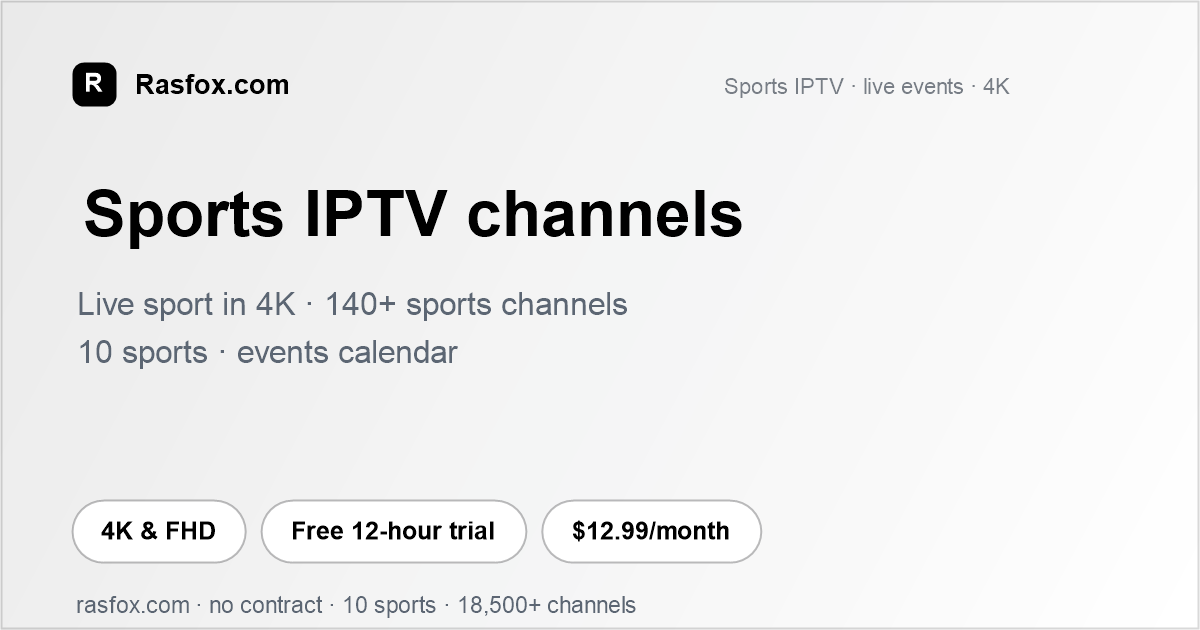
- Massive libraries: RasFox carries roughly 12,000 channels and 40,000 VOD titles, many in 4K at 50FPS — smooth enough that a fast counter-attack doesn't turn into a slideshow.
- Two screens at once: One match on the TV, another on the tablet. Perfect for the household with divided loyalties.
- No contract: No twelve-month lock-in, no cancellation phone call, no hidden fees.
- Support in Portuguese and Spanish: Because nobody wants to explain a buffering problem in a third language.
In short: IPTV gives you the volume of channels you want at a fraction of traditional cable pricing, and it does it on hardware you probably already own.
The Comedy of Live Sport: How IPTV Supercharges Your Watch Party
Here's the thematic bridge nobody expects: comedy and live sport are the same genre. Both depend on timing, both are funniest in the moment, and both are completely ruined when the signal drops. A joke explained three days later is dead. A goal you watch three days later is just a highlight clip.
So how does IPTV make a watch party better? Let's count the ways.
1. You Never Miss the Setup
Pre-match build-up, the pre-game punditry, the panel arguing about the lineup — this is where half the running jokes are born. With a proper channel line-up you get the full broadcast, not just the 90 minutes.
2. More Games Means More Banter
When you can flip between the Brasileirão, the Libertadores, the Champions League and a late-night UFC card, your group chat never goes quiet. Variety is the raw material of comedy, and IPTV hands you an impossible amount of it.
3. No Buffering, No Broken Rhythm
Nothing kills a punchline like a spinning loading wheel. A good IPTV service — the kind that streams live football without buffering — keeps the momentum intact. That's the entire point.
4. Watch Anywhere the Party Is
Backyard barbecue, beach house, that friend's apartment where the WiFi is surprisingly good. IPTV travels with you, which means the watch party isn't tied to your living room.
5. Two Screens, Two Stories
Two simultaneous connections means one person can follow the match while another catches the post-game show. Everyone gets their own angle, and the argument afterwards is fully informed.
Deep Dive: The IPTV Landscape in Brazil
Brazil is one of the most competitive streaming markets on earth. Football is not a hobby here; it's a second language. Roughly speaking, the market splits into three groups:
- Traditional cable and satellite — reliable, but expensive and bundled with channels nobody watches.
- Single-purpose streaming apps — great for one competition, useless when the season ends or when you want something else on.
- IPTV services — one subscription, thousands of channels, every major competition in one interface.
The third option is the one growing fastest, precisely because Brazilian fans don't want to juggle five apps to watch one weekend of football.
Sports Channels Brazilian Fans Expect
A sports-first IPTV line-up for Brazil typically includes:
- Globo — the traditional home of the big matches
- SporTV and Premiere — the backbone of Brazilian football coverage
- ESPN Brasil and BandSports — analysis, international leagues and everything in between
- Combate — for the MMA crowd
- TNT Sports BR — continental and European nights
- International options: ESPN, DAZN, Fox Sports, beIN Sports, Sky Sports and Eurosport
And the competitions? Brasileirão, Libertadores, Champions League, Premier League, La Liga, Liga Argentina, Liga Portugal, Formula 1 and UFC — the full calendar, essentially.
Built by People Who Take Sport Seriously
There's a detail worth knowing about the team behind RasFox IPTV. Its roots are in Radio Malena 89.1 FM, Buenos Aires — Venezuela 370, a station steeped in tango and Argentine cultural tradition. That background in live broadcasting matters. People who have spent years behind a microphone understand that a dropped signal isn't an inconvenience, it's a betrayal. RasFox took that broadcast mentality and pointed it at IPTV, with a deliberate, near-total focus on sports channels and live sports events for lusophone and Latino audiences around the world.
That's why the service is tuned for the things that actually matter to a football fan: fast channel switching, stable feeds during peak kickoff windows, and 4K 50FPS streams that don't turn into pixel soup when the crowd starts singing.
Hardware and Setup: What You Actually Need
One of the best things about IPTV is how little equipment it requires. If you've already cut the cord, you're most of the way there.
The Short Version
- An internet connection of 25 Mbps or more. That comfortably handles 4K. For Full HD, 10–15 Mbps is usually fine.
- A device. Amazon Fire Stick, Android TV box, Smart TV with a compatible app, Apple TV, Chromecast, a phone, a tablet, or even a PC.
- A stable router. Wired Ethernet beats WiFi every time if you can run a cable. If you can't, keep the device close to the router.
- A subscription. That's it.
Setup in Four Steps
- Choose your plan and complete the signup — no long-term contract required.
- Install the recommended player app on your device of choice.
- Enter the credentials you received.
- Let the channel list load, then start with the sports folder.
Total time: usually under fifteen minutes. If anything gets stuck, support is available in Portuguese and Spanish, which removes the single most annoying part of setting up any streaming service.
And if you're not sure yet? You can test the IPTV service free for 24 hours before spending anything. Watch a full match night, check the picture quality, see how the feed behaves during the busiest kickoff slot of the week. Then decide.
Legal vs Illegal IPTV: Safety and Best Practices
Let's address the elephant in the room, because it matters.
IPTV as a technology is completely legal. It's simply a delivery method — the same principle behind Netflix, YouTube Live or any broadcaster's own streaming app. What determines legality is licensing: whether the operator has the rights to redistribute the channels it carries.
Grey-market IPTV services exist, and they tend to share the same fingerprints:
- Prices so low they can't possibly cover content licensing
- No company information, no terms of service, no support channel
- Constant buffering, channels vanishing overnight, no VOD library
- Payment only via untraceable methods
A legitimate provider looks different. You get transparent pricing, working customer support, a stable channel list, an actual free trial so you can verify quality before paying, and clear communication about what the service is and isn't.
Practical safety rules for anyone in Brazil:
- Choose a provider with real, reachable support and a documented refund policy.
- Never hand over card details to an anonymous Telegram seller.
- Use a reputable payment method you can dispute if something goes wrong.
- Test the service during peak hours — that's when weak providers fall apart.
- Keep your expectations realistic: a service that promises every premium channel on earth for the price of a coffee is usually too good to be true.
For readers who want the short version: go with a service that behaves like a business. Something like the best IPTV service for live football — one with a sports-first catalogue, 12,000 channels, 40,000 VOD titles in 4K 50FPS, two simultaneous screens, no contract and a free trial — is a far safer bet than a mystery seller with a PayPal link and no name.
Why a Sports-First IPTV Service Beats a General One
Most IPTV providers sell "everything". Sports-first providers build for a specific moment: kickoff.
That difference shows up in practice:
- Peak-hour stability. Sunday afternoon and midweek European nights are when servers get hammered. Sports-focused infrastructure is sized for exactly those windows.
- Better picture quality where it counts. 4K 50FPS matters most during fast motion — a counter-attack, a boxing combination, a Formula 1 overtake.
- Proper sports organisation. Channels grouped logically, so you're not scrolling through 400 shopping channels to find SporTV.
- Multi-screen by default. Two connections means the football and the UFC can coexist in one household.
If your main reason for watching live TV is sport — and especially if your second reason is laughing about it afterwards — a specialist is almost always the smarter pick.
Final Whistle: Your Next Great Story Starts With a Live Match
Comedy is built on shared moments. Football produces them at industrial scale: the impossible comeback, the missed sitter, the commentator who says something so strange it becomes a catchphrase for the next five years. None of that lands if you watch it on a delay, and none of it is worth a cable bill that costs more than your electricity.
IPTV solves both problems at once — more channels, better picture, no contract, and a sports line-up built for people who actually care about the result.
If you've been meaning to try it, start with a match night. Grab the 24-hour free trial, load it onto the Fire Stick or the Smart TV, and see what a properly built sports IPTV service feels like when the Brasileirão is on and the group chat is already three jokes ahead of the commentary.
Ready to stop missing the punchline? Head over to RasFox IPTV, pick a plan, and get the channels loaded before the next kickoff.
FAQ: IPTV in Brazil, Answered
Is IPTV legal in Brazil?
The technology itself is legal. What matters is whether the provider holds the appropriate distribution rights. Choose a service with transparent pricing and real customer support rather than an anonymous seller offering impossible prices.
How much internet speed do I need for IPTV in 4K?
Around 25 Mbps per stream for 4K at 50FPS, and 10–15 Mbps for Full HD. If you're running two screens at the same time, plan for the combined total.
Can I watch Globo, SporTV and Premiere through RasFox?
RasFox is built with a heavy sports focus, with a line-up covering Brazilian and international sports channels — including Globo, SporTV, Premiere, ESPN Brasil, BandSports, Combate and TNT Sports BR — plus major competitions like the Brasileirão, Libertadores and the Champions League.
What equipment do I need to get started?
Very little. A Fire Stick, Android TV box, Smart TV, Apple TV, phone, tablet or computer, plus a stable internet connection. Setup typically takes under fifteen minutes.
Is there a free trial before I subscribe?
Yes. RasFox offers a 24-hour free trial so you can test picture quality, channel stability and channel selection during real live events before committing to a plan.
Do I have to sign a long-term contract?
No. There's no contract and no cancellation hassle — which is exactly how it should be for something you're using to watch a football match and laugh at the aftermath.